A Day in the Life: The Qalupalik
The World Under the Ice
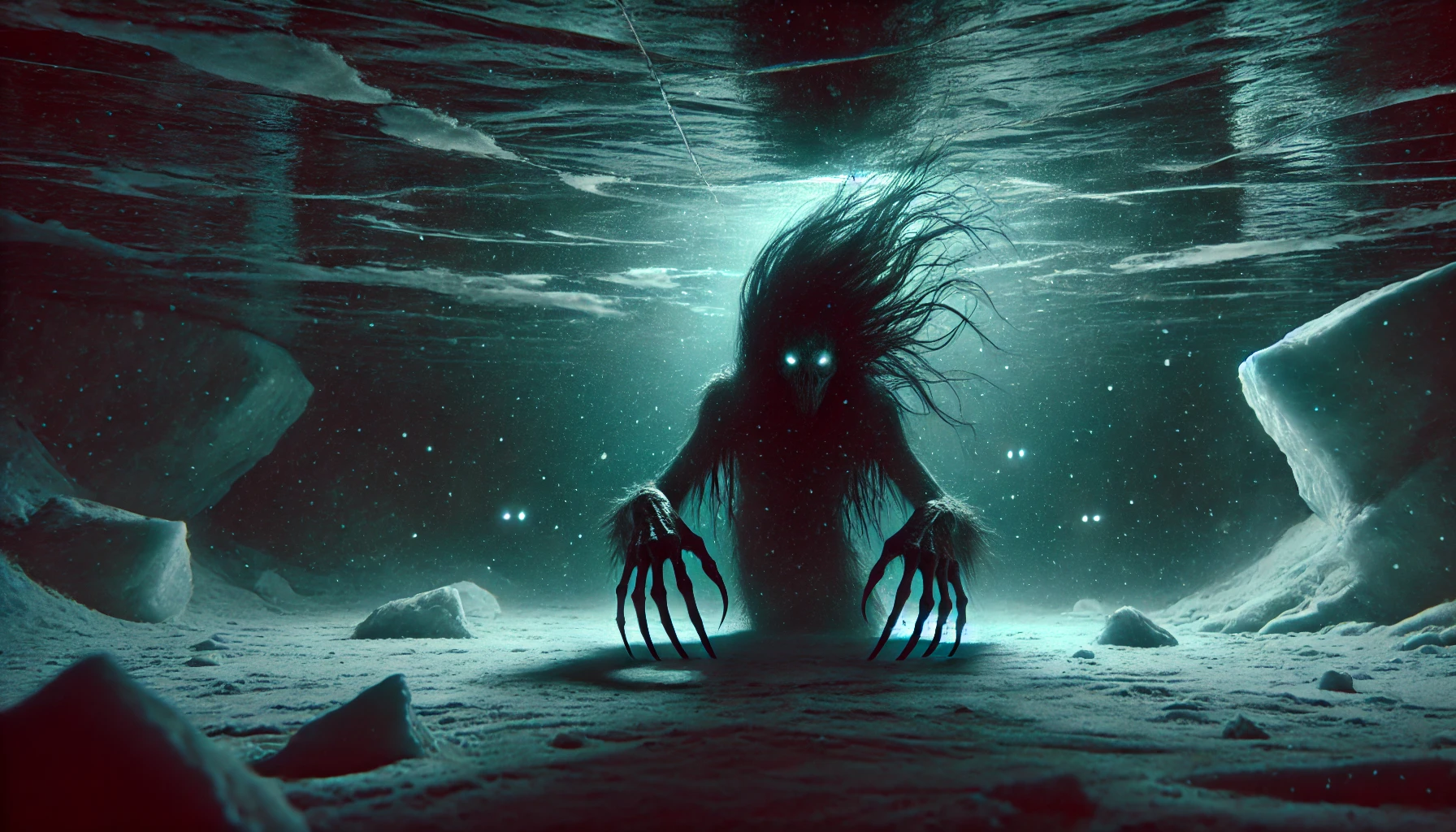
The Arctic Ocean is a ceiling of white. Above the ice, the wind howls at fifty miles an hour, driving snow into drifts that can bury a house. Below, the water is still and impossibly cold, hovering just above the freezing point—a world of silence and pressure.
Swimming through this dark, brine-filled world is the Qalupalik. She is a mermaid of the north, but she has no graceful fish tail. Instead, she possesses human legs ending in fin-like feet, propelling her through the depths. Her skin is a sickly, toxic green, scaly and slimy to the touch, and her hair floats around her like wild seaweed. Her fingers are long, tipped with sulfur-yellow claws capable of crushing bone.
She wears an amautik, the traditional parka of Inuit women. But hers is not made of warm caribou skin; it is crafted from eider duck skins, waterproof and reeking of old oil. The hood is huge, designed to carry a baby. But the hood is empty. That is the problem. It is a void that demands to be filled.
The Ventilation Hole
She swims upward, needing air, though she can hold her breath for hours. Finding a seal hole in the ice, she surfaces, just her nose and eyes breaking the tension of the water. The air is sharp, stinging her nostrils with the scent of snow and polar bear.
In the distance, she spots a village—small houses huddled against the white expanse for warmth. She sees movement. Children are playing near the shore, jumping on the unstable ice floes. They are laughing, ignorant of the danger. They are too close to the edge. A smile splits her green face, revealing a mouth full of jagged teeth.
The Humming
She begins to hum. Hmmmm-mmmmm-mmmmm.
It is a strange, resonant sound that travels through the ice. It sounds like the wind singing in the cracks, or the groaning of the shifting pack ice. But there is a rhythm to it, a sinister lullaby quality that pulls at the curiosity. The children stop playing. "Do you hear that?" The sound draws them in. It makes them curious. They move closer to the water's edge, peering into the dark depth, searching for the source of the song.
The Snatch
The Qalupalik dives, swimming beneath the ice and tracking their shadows silhouetted against the weak sun. She positions herself perfectly. She bursts through the surface. Ice shards fly like shrapnel. Before the children can scream, she grabs the closest one—a boy who had wandered too far. Her long fingers wrap around his ankle with a grip like iron.
She pulls. He slides across the ice, scratching at the snow, but finding no purchase. "Help!" He is gone. She drags him underwater. The cold shock hits him instantly, stealing his breath as he swallows salt water.
The Pouch
She does not eat him. She stuffs him into the pouch of her amautik. Inside, it is surprisingly warm, smelling of rotten kelp and ancient magic. The boy is trapped. The magic of the parka keeps him alive; he will not drown, and he will not freeze. But he will never grow up.
He joins the others—the faint, sleeping forms of children taken years ago. They are her family now. She is the mother who loves too much, the mother who never lets go, keeping them suspended in a cold, eternal childhood.
The Return to the Deep
The other children on the surface run away, screaming for their parents. The elders rush out with harpoons, but they are too late. The water is still again, the ripples freezing into new ice.
The Qalupalik swims down, deep into the black abyss. She pats the bulge in her parka, satisfied. She coos to the child, a gurgling, underwater sound. "Hush now," she seems to say. "You are safe. You are mine." She disappears into the darkness, a boogeyman of the ice, waiting for the next child who refuses to listen.