The Cave in the Karst
The heat of the day lingers in the limestone rocks of the Puerto Rican karst country. Deep inside a fissure, hidden by dense jungle vines and the heavy scent of orchids, the creature stirs.
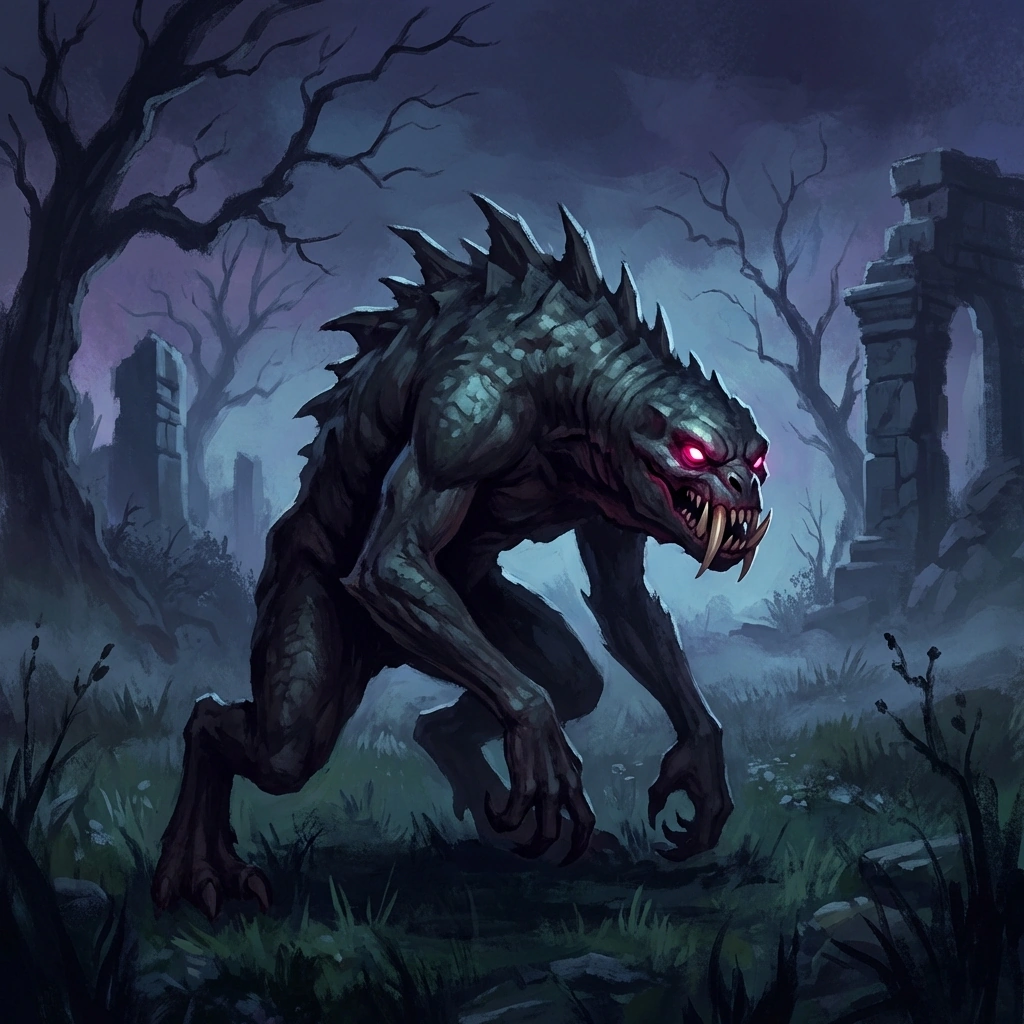
Uncurling with a series of wet, clicking sounds, it reveals itself as biology gone wrong—an impossible hybrid of lizard, kangaroo, and grey alien. Standing three feet tall in its crouch, it can rise to five. Its skin is a mottled grey-green, scaly like an iguana yet warm to the touch. Along its spine runs a row of sharp, semi-translucent quills that pulse with a faint bioluminescence when excited.
This is the Chupacabra. The Goat Sucker.
Large, oval eyes blink in the darkness. Black and devoid of whites, they reflect the minimal light of the cave like obsidian mirrors. Hunger gnaws at its gut. The copper scent of blood memory makes its mouth water, dripping thick saliva onto the cave floor. It needs iron. It needs the life force of high-grazing mammals.
The Stalking
Moving through the underbrush with unnatural speed, it does not run. Instead, it hops, propelling itself with powerful hind legs that terminate in three-toed, clawed feet. Thump-thump-thump. The sound is soft, barely audible over the chirping of the coquí frogs.
The jungle reacts to its presence. As it passes, frogs fall silent. Sleeping birds wake and bristle in their nests, sensing a predator that does not belong to the natural food chain.
Reaching the edge of a hillside farm near Canóvanas, a chain-link fence separates the jungle from the pasture. The Chupacabra observes. Its brain, large and complex, processes the scene like a computer, creating a thermal map of the area: the heat signature of the farmhouse, the sleeping dog, the huddled warmth of the goat pen.
The Hypnotic Gaze
Approaching the dog house, the mongrel inside—a tough island mix—stirs and growls. Sensing the alien musk, a smell like sulfur and battery acid, the dog rushes out to bark.
The Chupacabra freezes. It does not retreat. Locking eyes with the dog, it asserts dominance.
The creature's eyes begin to glow with a distinct red phosphorescence. Emitting a low frequency hum, a vibration that operates below the range of human hearing but rattles the skull of canines, it subdues the animal. The dog whines. Aggression melts into confusion, then lethargy. Laying its head back on its paws, it succumbs to a strange, induced sleep. The guardian has been neutralized.
The Feeding
The path is clear. Hopping over the fence with frightening ease, the Chupacabra lands silently in the goat pen. Livestock smell of musk, grain, and fear. They bleat nervously, crowding into the corner, horizontal pupils wide with panic.
Selecting its prey—a healthy doe—the Chupacabra does not maul wildly like a wild dog or tear flesh. It pounces with surgical precision. Grappling the goat, it covers the snout with a clawed hand to silence it.
Fangs sink into the neck. These are not simple teeth, but hollow needles evolved for extraction. It injects a paralytic agent and an anticoagulant. The goat goes limp instantly.
Feeding is clean, almost industrial. Drinking deeply, throat pulsing rhythmically, the creature drains the blood essence, leaving the meat untouched. It acts as a vampire of efficiency, seeking only the liquid vitality. In minutes, the goat is a husk, lighter and smaller than it was in life. Dropping the carcass, three distinct puncture marks form an inverted triangle on the neck—the signature of the beast.
The Escape
A light turns on in the farmhouse. A door slams. The farmer has woken up, perhaps sensing the sudden silence of the goats. A beam of a flashlight cuts through the dark.
Hissing, the Chupacabra flares its spinal quills. They flash with neon colors—red, blue, green—a warning display intended to startle.
Turning, it leaps. Clearing the six-foot fence in a single bound, it defies gravity, disappearing into the jungle canopy before the farmer can even raise his rifle.
Back in the safety of the limestone cave, the creature grooms itself, cleaning its claws with a long, forked tongue. Sated, the hunger replaced by cold satisfaction, it curls up into a ball, wrapping its tail around its nose. The jungle sings its lullaby of predator and prey, and the alien prince sleeps, dreaming of red blood and the pale white moon.