Catoblepas: The Downward Looker
The Burden of Toxicity
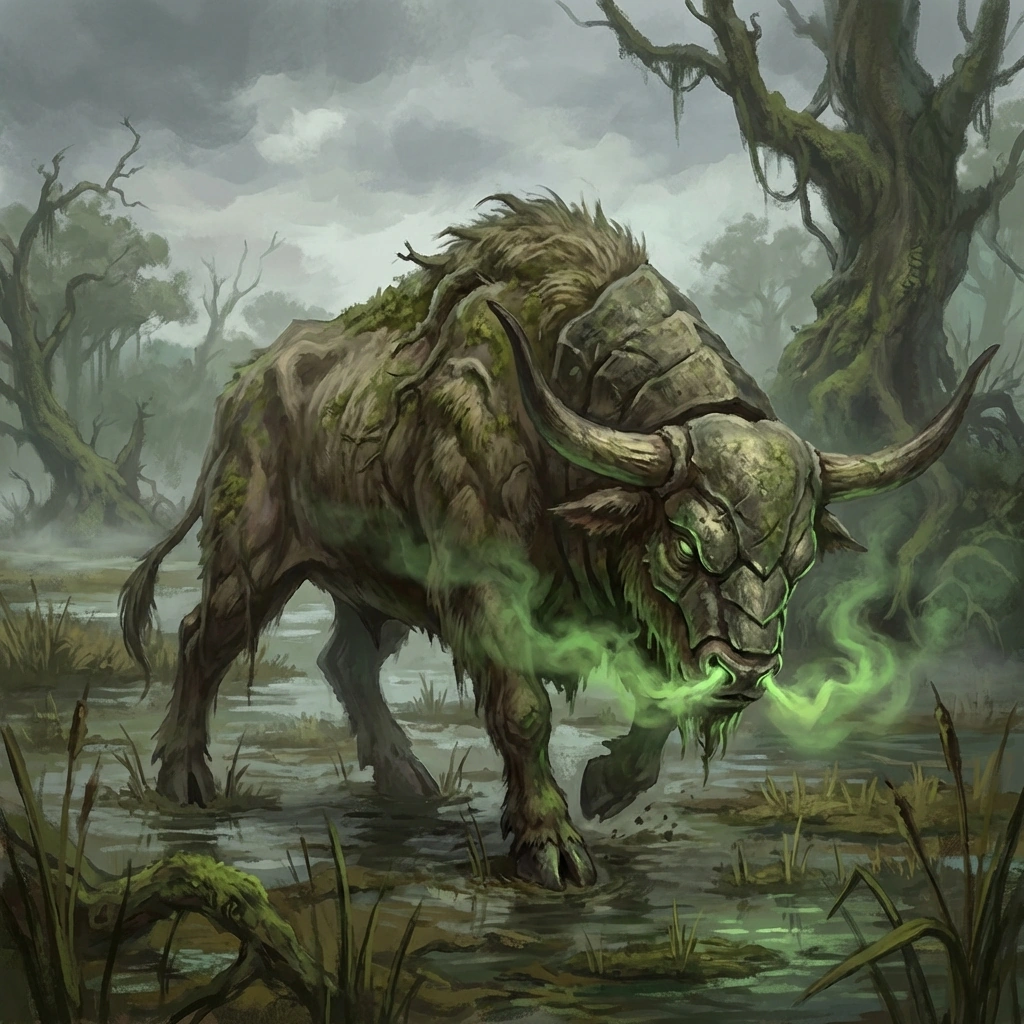
In the arid scrublands of Ethiopia, there wanders a beast defined by gravity and poison. It resembles a buffalo that has gone wrong—a massive, scaly body supported by legs that seem too weak for its bulk. But the defining feature is the neck.
The creature is the Catoblepas (Greek for "That Which Looks Downward"). Its head is so disproportionately large and heavy that the neck muscles cannot support it. The beast spends its life staring at the dirt, grazing on toxic herbs that would kill any other herbivore.
The Medusa Mechanism
The creature possesses a defense mechanism of absolute lethality. Its eyes are not merely sensory organs. They are biological weapons. Sightings by Roman naturalists (including Pliny) confirm that if the Catoblepas ever summons the strength to lift its head and lock eyes with a predator, the result is instant death. There is no struggle. The gaze stops the heart immediately. It is a mercy of nature that the head is so heavy. If the beast could look up at will, it would be an apex extinction event.
The Breath of Rot
The creature's diet consists of poisonous scrub and venomous roots. This toxicity permeates its biology. When the Catoblepas exhales or sighs, it releases a cloud of necrotic gas. This breath is capable of corroding skin and liquefying the lungs of anyone unfortunate enough to be downwind. Even if one avoids the gaze, the air around the beast is a kill zone.
Interaction Protocols
Survival requires maintaining the creature's status quo.
- Do Not Engage: It is a passive grazer. Loud noises or aggression may trigger an adrenaline response, giving it the momentary strength to lift its head.
- Stay Upwind: The toxic exhalation has a range of fifty meters.
- Observation: Viewing the creature from high ground (above its line of sight) is the only safe method of study.
The Final Warning
It walks slowly. It stumbles. It looks pathetic. Do not pity it. Do not whistle to get its attention. Let it look at the ground, because you do not want to see what color its eyes are.