Chimera: The Three-Headed Fire-Breather
The Impossible Bioweapon
In the mountains of Lycia, the natural order is broken. A creature descends from the peaks that defies taxonomy—a biological violation composed of three separate predators fused into a single functioning organism.
The Chimera is not just a beast. She is a living omen of disaster. She is the daughter of Typhon and Echidna, a sibling to Cerberus and the Hydra. But while her siblings guard specific locations, the Chimera is an active hunter. She burns fields, eats cattle, and incinerates entire villages with a breath weapon that melts bronze.
Three Beasts in One
The physiological description of the Chimera is consistent across classical texts (Homer, Hesiod), portraying a union of unrelated species.
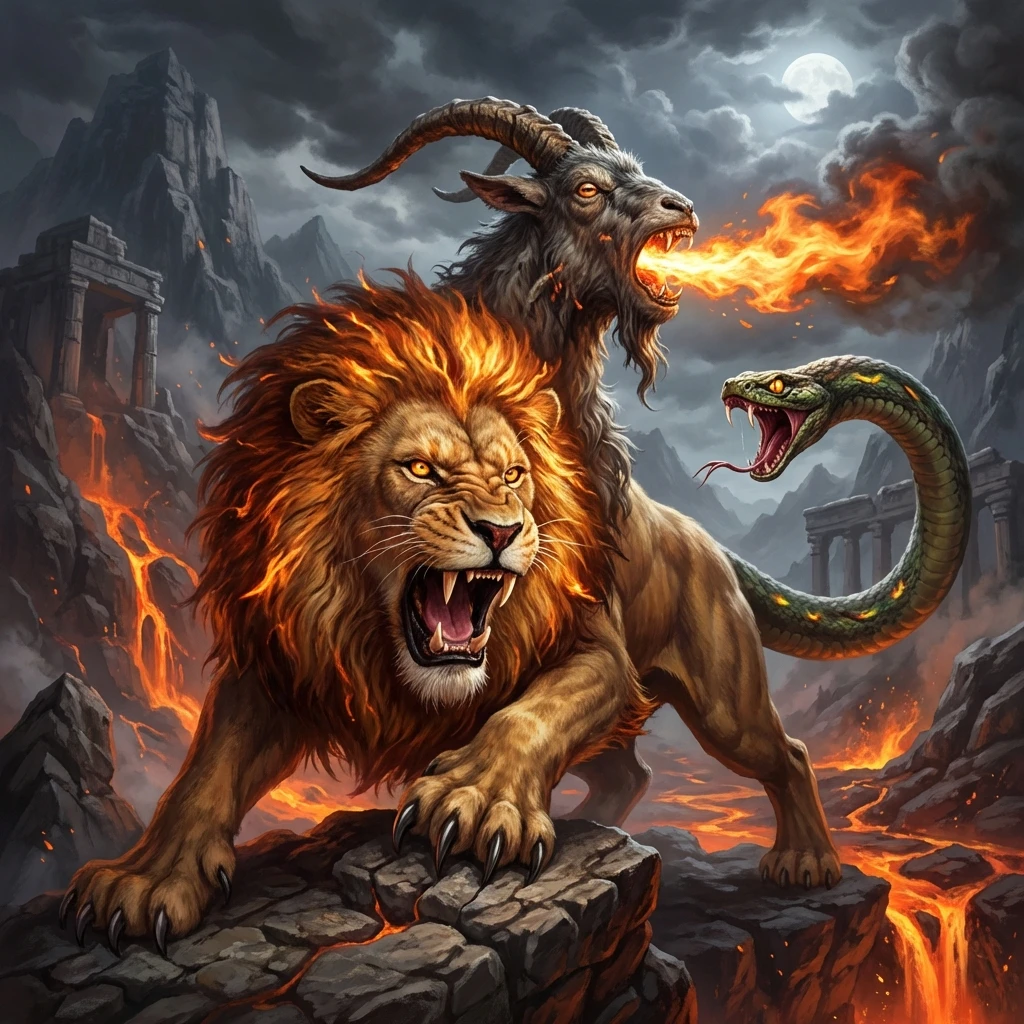
- The Lion: The front third of the body is a massive lioness. This head provides the biting power and the roar.
- The Goat: Sprouting from the spine is the head and neck of a goat. In most accounts, this is the most dangerous component—it is the source of the firestream.
- The Dragon: The tail serves as a third autonomous entity—a venomous serpent that strikes at flanking attackers.
The Aerial Bombardment
King Iobates of Lycia, desperate to remove the threat, sent the hero Bellerophon to kill the beast. Bellerophon realized that engaging the Chimera on the ground was suicide. The combination of fire, claws, and venom was unassailable.
He prayed to Athena, who provided a golden bridle to tame the winged horse, Pegasus. Taking to the sky, Bellerophon engaged the monster from above. The Chimera's fire could not reach him, but her hide was too thick for arrows to penetrate.
The Lead Bullet
Bellerophon improvised a thermal kill. He attached a block of lead to the tip of his spear. Diving from the clouds, he waited for the goat head to open its mouth to scream fire.
He thrust the spear into the throat. The heat of the Chimera's own fire breath melted the lead instantly. The molten metal poured down her gullet, cauterizing her internal organs and suffocating her from the inside out. It was a victory of engineering over brute force.
The Omen of Storms
The Chimera is dead, but her name survives as a classification for anything that is "impossible" or "hybridized." Historically, sighted "Chimeras" were likely misinterpreted sightings of volcanic phenomena or genetic mutations. But the warning remains: nature occasionally produces monsters that break the rules.
The Final Warning
If hiking in the volcanic regions of Turkey (Mount Chimaera), pay attention to the vents in the rock. The methane gas fires still burn there today, eternal flames flickering from the earth. The locals say the monster is buried beneath the mountain, so tread lightly.
Featured Creature Profile
Chimera
Chimera is a composite predator—lion at the fore, goat upon its back, and a serpentine tail—recorded in rocky, sun-baked ranges. Smell: a sharp, acrid tang of sulfur and singed hair, like a hearth gone wrong. Sound: a disturbing, threefold chorus—deep, resonant lion-roar; nasal goat-bleat; and a high, sibilant hiss—that can arrive staggered or all at once. Temperature: the air around it runs warm and dry, grass scorched in irregular patches and stones faintly warmed underfoot. Field notes: approach marks carefully—hoofprints stepping over deep claw gouges, and a shadow that seems to move with an uneven gait.