Fenrir: The God Eater
The Wolf at the Door
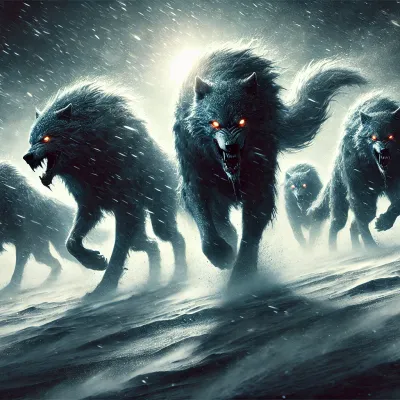
Cosmology typically depicts the end of the world as a fire or a flood. In Norse mythology, it is a mouth. Fenrir (The Fenris Wolf) is the biological engine of the apocalypse. Born of the trickster Loki and the giantess Angrboða, he is not merely a wolf. He is an ever-expanding entity of hunger. When first brought to Asgard, he was small. But his growth rate was exponential. Soon, his lower jaw touched the ground and his upper jaw brushed the sky. The prophecy was clear: This beast will kill Odin.
Gleipnir: The Impossible Chain
Conventional containment failed. Fenrir shattered the heaviest iron chains (Læding and Dromi) with ease. The gods commissioned the Dwarves of Svartalfheim to construct Gleipnir—a binding made not of metal, but of paradoxes:
- The sound of a cat's footfall.
- The beard of a woman.
- The roots of a mountain.
- The sinews of a bear.
- The breath of a fish.
- The spittle of a bird.
It appears as a silky ribbon, but it possesses infinite tensile strength.
The Hand of Tyr
Fenrir, suspecting a trap, refused to be bound unless a god placed their hand in his mouth as collateral. Only Týr, the God of Justice and War, volunteered. When the wolf realized the ribbon was unbreakable, he sheared Týr's hand from his wrist. The binding was successful, but the cost was the mutilation of justice.
The Escape Protocol
Fenrir currently resides on the island of Lyngvi, bound and gagged with a sword propping his jaws open. At Ragnarök, all bonds will break.
- Release: The ribbon snaps.
- Consumption: He will devour the sun and moon (or his sons will).
- Deicide: He will swallow Odin whole, ending the reign of the Aesir.
The Final Warning
If you feel the ground shake and hear a howl that cracks the glaciers, do not mistake it for a storm. The ribbon has snapped, and the Wolf is loose.