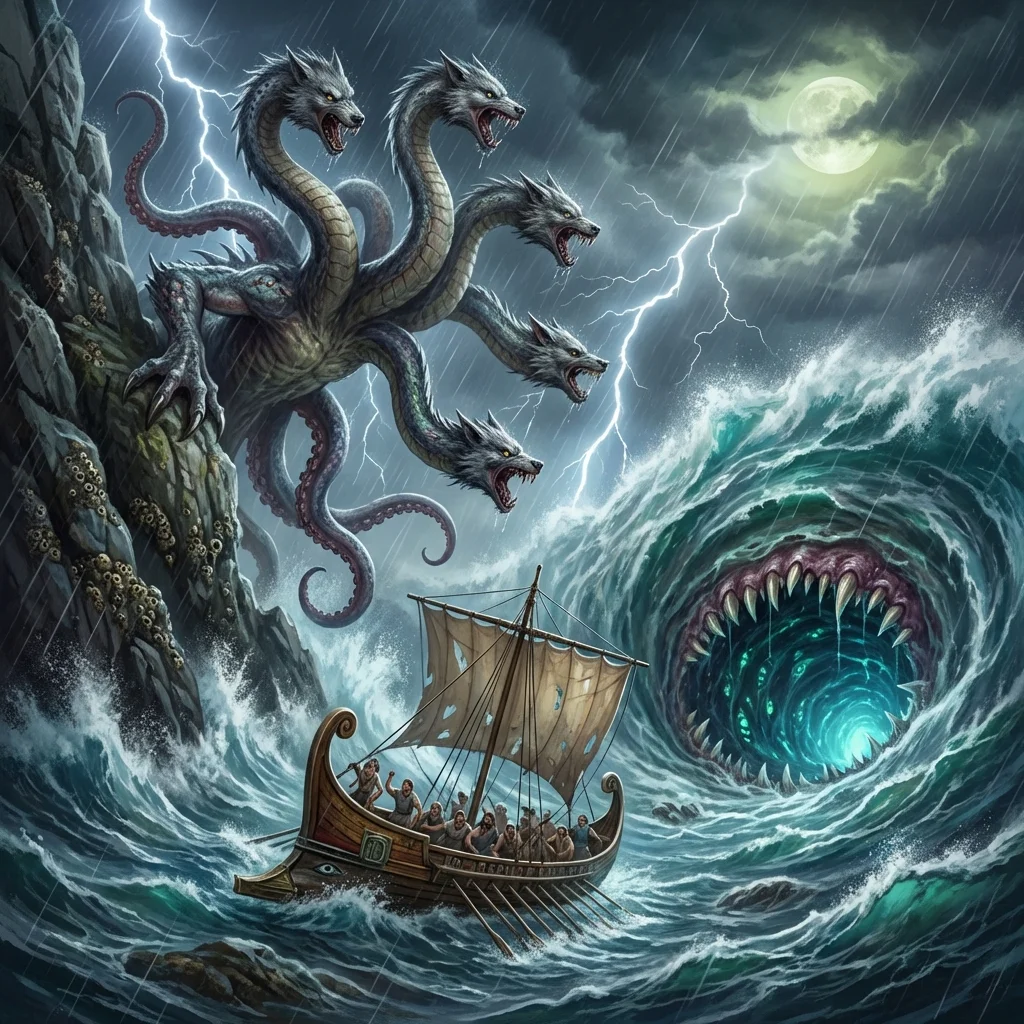
Scylla and Charybdis
Travelers in Greek speak of Scylla and <a href="/bestiary/charybdis" class="text-blue-400 hover:text-blue-300 transition-colors hover:underline hover:decoration-blue-500/50 decoration-1 underline-offset-2">Charybdis</a>, a sea monsters of navigation.
Scylla and Charybdis Lore & Origins
Scylla and Charybdis Encounter Protocols & Field Notes
- A concentrated band of foam and whirlpooling debris paired with intermittent, echoing barks from the cliffside; if the current starts drawing objects in a tight, circular motion near shore, one of the pair is active.
- avoidance: When possible, give the entire strait a wide berth: avoid hugging cliff faces and keep well clear of areas where currents form circular eddies. Do not anchor or heave to near suspected sites. If navigation forces you through, choose the path that keeps you farther from the active feature — historically, captains would accept the lesser loss rather than risk total loss by the whirlpool.
- defense: Maintain speed and steer for open water; keep sails and oars ready for quick maneuvering. Light signals and loud noises can distract or deter Scylla's heads long enough to pass, while coordinated, powered rowing and cutting lines can help a vessel escape the lip of a whirl. Prepare to jettison loose deck cargo to reduce drag; keep lookouts on both fore and aft to anticipate sudden shifts.
- offering: Small tokens to the sea — salted grain, libation of wine or oil — are recorded in sailors' practice as gestures asking for safe passage (more ritual than reliable protection).
Scylla and Charybdis Abilities & Powers
- The Strait's DilemmaOccupying opposite sides of a narrow channel they create an enforced choice: avoid one hazard only to fall prey to the other, turning navigation into a no-win ambush.
- Ship-Claiming SnatchFrom her rocky lair Scylla extends multiple dog-heads and grasping limbs to pluck sailors from decks and devour them while the hull remains afloat.
- Swallow-and-Spit MaelstromCharybdis inhales a vast volume of sea to form a catastrophic whirlpool that can drag vessels under and later expel wreckage in violent surges.
Weaknesses & How to Defeat the Scylla and Charybdis
- Lair SeparationRemoved from her cliff and the narrow channel Scylla's reach and coordinated strikes collapse, greatly reducing her threat to passing ships.
- Ebb TideCharybdis depends on tidal volume—at low tide she cannot form a full whirlpool and is reduced to a weak sucking pool incapable of swallowing ships.
- Arcane ReversalScylla's monstrous form originates in specific transformations (e.g., Circe's curse) and can be partially undone by equivalent high-grade magic or divine intervention.
Related Monsters

Who Would Win?
Think you know everything about the Scylla and Charybdis? Test your knowledge in our Battle Matchups simulator to see how it fares against other legendary creatures.
Recommended Reading
Expand your library with these top-rated books on global mythology & folklore

Mythology: Timeless Tales of Gods and Heroes
By Edith HamiltonThe absolute standard for Greek, Roman, and Norse mythology studies. Excellent source for understanding gods and classic monsters.

The Hero with a Thousand Faces
By Joseph CampbellExplores the monomyth (the Hero's Journey) across global folklore and mythic archetypes, outlining why these stories persist.
Affiliate Disclosure: As an Amazon Associate, we earn from qualifying purchases when you buy recommended books through our links.
Want to discover something else?
Fall down the mythic rabbit hole. Click below to discover a completely random creature from our archives.