Basilisk – The King of Serpents in Cyrene
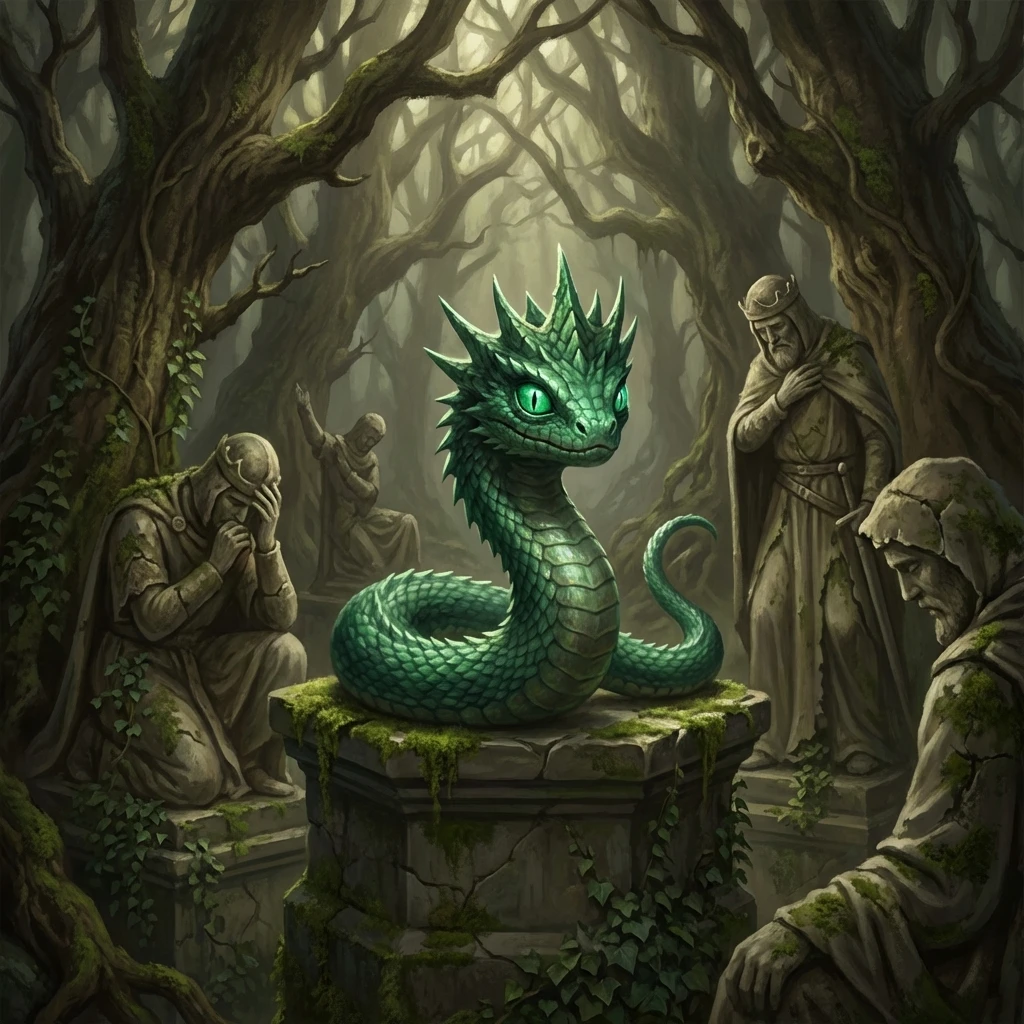
The desert of Cyrenaica was not empty; it was dead.
Centurion Marcus Valerius of the Third Augusta Legion reined in his warhorse at the edge of the limestone ravine. Around his small patrol of five legionaries, the landscape had undergone a grotesque transformation.
The wild tamarisk bushes and hardy desert acacia were not merely dry—they were scorched black, their branches brittle as charcoal, as if a furnace blast had rolled across the dunes. The ground was devoid of beetles, lizards, or desert scorpions. Even the carrion vultures, usually circling high above the caravan routes, gave this barren canyon a wide berth.
"This is the territory of the Regulus," whispered Decimus, the veteran Syrian scout, checking the leather strap of his polished bronze shield. "The Greeks call it the Basilisk. The King of Serpents."
"A snake, Decimus?" Marcus scoffed, though the unnatural silence made the hairs on his neck prickle. "A legionary marches with iron and discipline. No adder in the sands can pierce Roman lorica."
"You do not understand, Centurion," Decimus answered, his dark eyes solemn. "The Basilisk does not crawl upon its belly like common serpents. It carries itself upright, its crown held high above the dust. Its breath rots the grass, its trail cracks the rocks, and if a man on horseback pierces it with a spear, the venom travels up the shaft of the weapon to kill both rider and steed."
Marcus drew his short gladius, signaling his men to form a tight line with shields interlocked.
They advanced down into the limestone catacombs where ancient Greek settlers had carved burial niches centuries before. The air inside the tomb smelled of burnt sulfur and dried copper.
In the center of the subterranean chamber, curled upon a mound of crumbling marble dust, rested the creature.
It was no titan in size—barely three feet in length from snout to tail—yet its appearance commanded terror. Its scales were not the smooth brown of a desert viper, but iridescent gold and oily crimson, shimmering with unnatural luminescence in the torchlight. Atop its reptilian head sat a prominent, three-pointed crest of hard bone, resembling a royal diadem or crown.
Its eyes were pale, milky yellow, with horizontal slits of pitch black.
The creature raised the front half of its body off the stone, standing erect like a desert cobra, regarding the armed Romans with icy disdain.
It hissed.
The sound was not a dry rasp, but a high-pitched, metallic whistle that vibrated the bronze cheekpieces of their helmets. A faint, greenish mist billowed from its needle-sharp fangs.
One of the younger legionaries stepped forward, thrusting his iron-tipped pilum forward.
"Avert your eyes! Cover your mirrors!" Decimus shouted.
The soldier hesitated, locking eyes with the golden crown of the beast.
Instantly, the color drained from the young Roman's face. The bronze javelin slipped from his numb fingers, clattering on the stones. His skin took on the waxy, grayish hue of cooled tallow; his limbs stiffened into rigid paralysis as the neurotoxic vapor entered his lungs, arresting his heart mid-beat.
Marcus did not look at the serpent. He remembered the writings of Pliny the Elder, read by candlelight in the garrison library of Leptis Magna: To conquer the King of Serpents, one must not use iron, but reflection and the crow of the cock.
Reaching into his wicker forage bag tied to his belt, Marcus pulled out a burlap sack. From within, he hauled out a live barnyard rooster, acquired that morning from a Berber merchant at the desert oasis.
The bird squawked loudly, thrashing its russet wings in panic in the dark cavern.
The Basilisk recoiled. Its crown lowered, its pale eyes dilating in unmistakable dread.
Marcus squeezed the rooster’s breast. The rooster threw its head back and let out a piercing, triumphant crow—the clarion call of dawn, the cosmic signal that dispels shadows and nocturnal horrors.
The sound resonated through the vaulted stone tomb.
The Basilisk shrieked—a shrill, pained squeal of acoustic agony. The primordial frequencies of the rooster’s call shattered the serpent’s nervous system, causing it to thrash wildly against the stone floor, its golden scales scattering into brittle dust.
Marcus drew his round bronze cavalry mirror from his saddle pack, positioning it directly in front of the writhing beast.
The serpent struck blindly at its own reflection. The moment its lethal gaze met the mirrored image of its own eyes, the beast froze, shuddered from crest to tail, and dissolved into a pile of smoking, calcified ash.
Marcus let out a long, ragged breath, looking down upon the fallen soldier and the crumbling remains of the serpent king.
He ordered the catacomb entrance sealed with ten cartloads of limestone boulders, posting a carved warning in Latin and Greek: Here walked the Regulus. Let no man disturb the dust.
Bring This Myth Into Your World
Support independent folklore storytelling and bring home our original collectibles, field guides, and tabletop games.
Designer Art Toys
Premium designer vinyl figures and pre-supported 3D printable STL files created for art toy collectors and painters.
Field Guide Tome
The definitive hardcover & digital explorer manuscript documenting 405 ancient creatures, danger ratings, and lore charts.
Tabletop Board Games
Summon deities, navigate cursed labyrinths, and hunt mythic beasts in our tactical board games and print-and-play decks.
Get the Free Print-and-Play Mythic Expansion
Join 3,000+ monster hunters. Receive printable lore cards, early access to limited toy drops, and new weekly folklore chapters directly to your inbox.